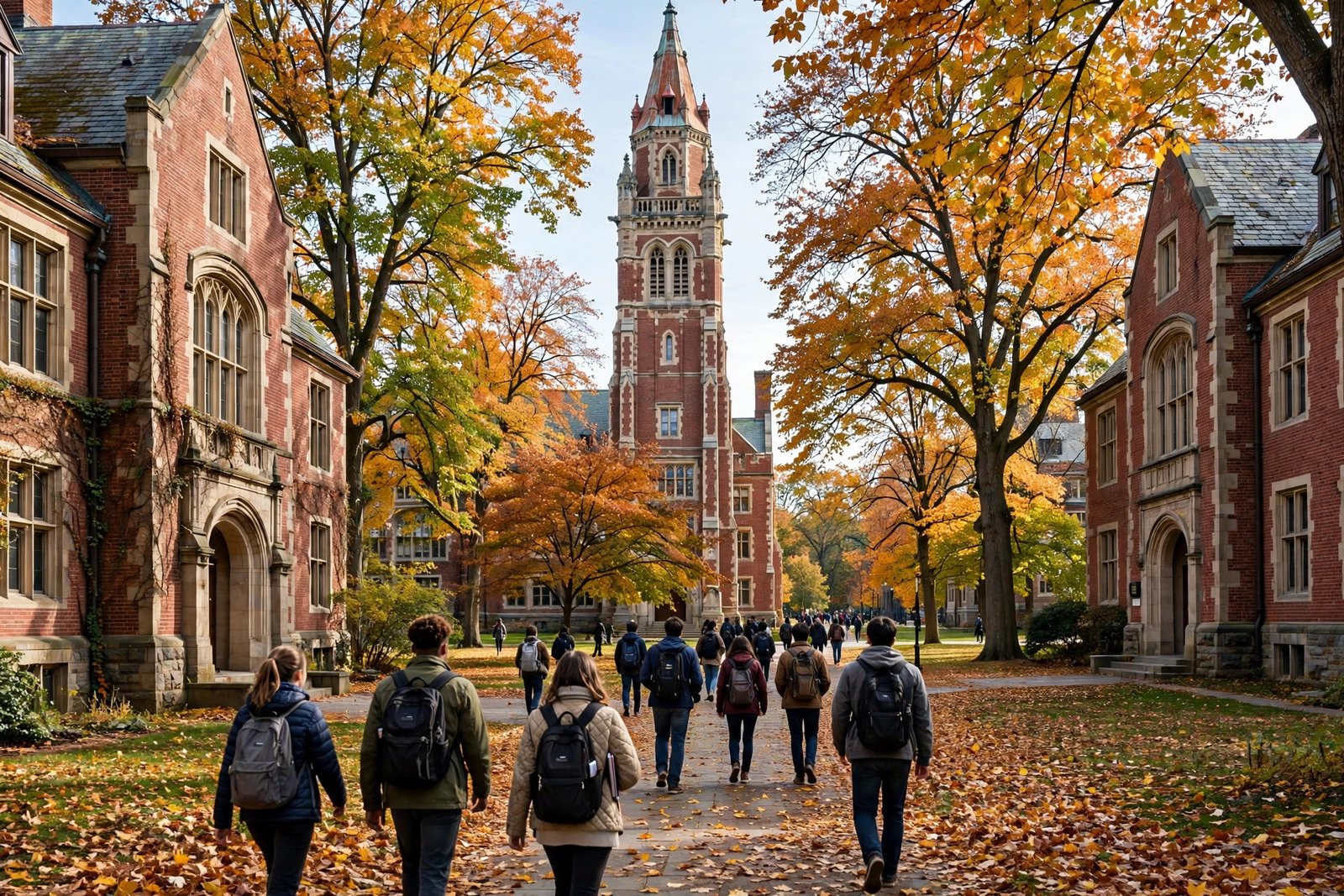
To study in the USA from the UK, apply through the Common Application in the autumn of Year 13 and get an F-1 visa. You need GCSE and A level results, a 650 word essay, teacher references and, at some universities, SAT or ACT scores. Costs start at $31,880 a year at public and $45,000 at private universities, before aid.
More than 10,500 students from the UK were enrolled at US universities in 2024/25, according to the Institute of International Education, quoted by Prospects. The USA is the largest higher education system in the world, with over 4,500 degree granting institutions, and four US universities sit in the top 10 of the QS World University Rankings 2026. The attraction is real, but so is the difference from the UK system. There is no UCAS, degrees take four years, you choose your subject later, and the price on the website is rarely the price you pay. This guide walks through the whole route for a UK student: how US applications work, what to prepare, what it costs in pounds, how financial aid works, and the F-1 visa step by step. Every figure was checked on 25 November 2026 against the US Department of State, the Department of Homeland Security Study in the States pages, the College Board, the Common Application, the Institute of International Education and the universities named. Pound figures use about £1 = $1.34, the European Central Bank reference rate of 30 October 2026, and are approximate because rates move every day.
How is studying in the USA different from the UK?
The first thing to unlearn is UCAS. In the UK you make one application, pay one fee of £28.50 for 2026 entry, list up to five choices and write one personal statement. In the USA there is no single national system. You apply to each university separately, usually through the Common Application, which covers more than 1,000 colleges, or through a university’s own portal. Each application has its own fee, its own essays and its own deadline. A UK degree also starts with a subject chosen at 18 and lasts three years in England. A US bachelor’s degree lasts four years, starts broad, and lets you choose your major after a year or two of general study. That suits students who are not ready to specialise, and it suits students who want to combine subjects, for example economics with computer science.
| UK | USA | |
|---|---|---|
| Application system | UCAS, one application for up to five choices | Common Application, Coalition Application or each university’s own portal |
| Application fee | £28.50 for 2026 entry, one fee for up to five choices | Typically $40 to $150 per university, for example $85 at Harvard and $90 at Stanford |
| Degree length | Three years in England, four in Scotland | Four years for a bachelor’s degree |
| Choosing a subject | Chosen when you apply, at 18 | Major chosen after a broad first year or two |
| What matters most | Predicted A level grades and one personal statement | Grades, essays, references, activities and, at some universities, test scores |
| Tuition fee, home student | Maximum £9,790 a year in England in 2026/27 | No home rate for UK students; international students pay the full published price |
| Student loan | Government loan, repaid through salary | No UK government loan for a US degree; aid comes from the university |
| Visa | None needed for UK students in the UK | F-1 student visa, with an interview at the US Embassy in London or the Consulate General in Belfast |
Two other differences catch UK applicants out. First, US universities grade by continuous assessment: homework, quizzes, mid-term exams, papers, finals and class participation, all feeding into a grade point average, or GPA. There is no single final exam season like A levels. Second, medicine and law are not undergraduate subjects in the USA. You study a first degree, then apply to medical school or law school afterwards. If you want to be a doctor or a lawyer, read our guides to applying for medicine in the UK and applying for law in the UK before you assume the US route is shorter, because it is not.
What do US universities look for in a UK applicant?
US admissions are holistic, which means no single number decides your place. A university reads your whole file: your school record, your tests if you send them, your essays, your references and what you do outside class. That is a bigger file than a UCAS application, and it takes longer to build. Here is what each part means for a UK student.
Your school record. Universities want your GCSE results, your A level or IB predictions and results, and a report from your school. There is no official conversion between UK grades and the US GPA, so each university reads your grades in context. Taking hard subjects and doing well in them matters more than the number of subjects. Your school counsellor, usually your head of sixth form or a designated teacher, also sends a school report that explains your school’s grading and where you sit in your year.
Essays. The Common Application asks for one personal essay of up to 650 words, plus extra essays for each university, called supplemental essays. These matter far more than a UCAS personal statement. A UCAS statement explains why you want the subject. A US essay shows who you are, how you think and what you have done. Write in your own voice, about one real experience, and do not let anyone else write it for you. Colleges treat ghost written essays as dishonest, and admissions tutors can tell.
References. Most universities ask for a counsellor recommendation and one or two teacher recommendations. Ask teachers who know you well and who can write about your work in detail, not the most senior teacher in the school. Give them at least a month, a short note about what you are applying for, and your deadlines. Our guide to UCAS deadlines for 2027 entry explains how to brief a referee, and the same habits work for US references.
Activities. The Common Application lets you list up to 10 activities, with a short description of each. Depth beats volume. Three years in one society, a part time job, a sport, volunteering or a project you built all count. What admissions tutors look for is commitment and leadership over time, not a long list of one off events. If you have nothing to list, start now: a regular commitment in Year 12 is worth more than five clubs joined in the last month of Year 13.
English language. British students are usually exempt from English tests because they are native speakers, but the university decides. If you are asked for proof, the usual tests are TOEFL, IELTS or the Duolingo English Test. Check each university’s own page rather than assuming.
Do I need the SAT or ACT?
Maybe, and the answer depends on where you apply. The SAT and ACT are standardised tests taken in addition to your A levels. Many US universities are now test optional, which means you can choose whether to send a score. Several selective universities have gone the other way and now require a score again, including Harvard, Yale, MIT, Dartmouth, Brown and the California Institute of Technology. Never guess: check the testing policy on each university’s admissions page before you decide, because the policy is set by the university and it changes.
| SAT | ACT | |
|---|---|---|
| Run by | College Board | ACT Inc |
| Format | Fully digital since 2024, taken on the Bluebook app | Paper or computer, depending on the test centre |
| What it tests | Reading and writing, and maths | English, maths, reading and science, with an optional writing section |
| Registration fee | $68, plus a $43 international fee when you test outside the USA, so $111 in total for a UK test taker | From $70, with extra for science and writing |
| Test dates 2026-27 | Eight Saturday sittings, starting Saturday 22 August 2026 | Several sittings a year at UK test centres |
| Score sends | Four free score reports if you choose them when you register or within nine days after the test, then $15 per extra report | Similar free sends, then a fee per extra report |
| Late registration | $38 extra | A late fee applies |
Three practical points. First, book early. UK test centres fill up, and the August and October sittings in Year 13 are the ones that matter for early deadlines. Second, a strong score helps at a test optional university only if it is strong for that university. A score below the university’s published middle range can weaken an application that would otherwise be read on grades and essays alone, so compare your score with the range the university publishes before you send it. Third, fee waivers exist but are mostly for students testing in the USA. The College Board offers fee waivers to low income students in the USA and US territories, and to US citizens living abroad, so most UK students should budget the full $111 for the SAT.
How do I apply? The Common Application step by step
Most UK students apply through the Common Application, which opens on Saturday 1 August each year. You fill in one profile, one main essay and your activities list, then add each university and answer its extra questions. Some universities, such as the Massachusetts Institute of Technology and the University of California campuses, do not use the Common Application and ask you to apply on their own portals instead. The steps below are for entry in autumn 2027, the cycle that opens in Year 13 for most applicants.

1. Build a balanced list of 8 to 12 universities. Split it into reach, target and likely choices. Reach universities are ones where your grades sit below their usual range. Target universities are ones where your grades sit in the middle of their range. Likely universities are ones where your grades sit above their range and where you would be happy to go. Do not apply to 20 universities. Each one costs $40 to $150 and needs its own essays, and a long list means thin essays everywhere.
2. Sit the SAT or ACT in the summer before Year 13 if your list needs it. August and October sittings leave time for a retake. Do not leave your first sitting until the spring of Year 13, when your early deadlines will already have passed.
3. Ask for references in September of Year 13. Give your teachers a month and a clear note of each deadline. Your counsellor also has to send a school report, so tell them early that you are applying to the USA, because the forms are different from UCAS.
4. Write your main essay over the summer, then the supplemental essays in the autumn. Draft, leave it for a week, then rewrite. Read it aloud. If it sounds like anyone could have written it, it is not finished.
5. Apply for financial aid at the same time as admission, if you need it. Most universities ask international students for the CSS Profile, a financial form run by the College Board, plus your parents’ income documents. Some use their own form instead. Aid deadlines often fall on the same day as the admission deadline, so do not leave the aid forms until after you apply.
6. Submit, then wait. Early decisions come back in December. Regular decisions come back in March and April. Most universities ask you to reply by 1 May. Do not pay a deposit to more than one university: that is called double depositing, and universities can withdraw both offers if they find out.
| When | What to do |
|---|---|
| Year 12, spring and summer | Research universities, visit virtual tours, sit the SAT or ACT, draft your main essay |
| Saturday 1 August 2026 | Common Application opens for autumn 2027 entry |
| September 2026 | Ask teachers and your counsellor for references; confirm each university’s testing and aid policy |
| Sunday 1 November 2026 | Early Decision and Early Action deadlines at most universities; some use Sunday 15 November 2026 instead |
| December 2026 | Early decisions released |
| Friday 1 January 2027 | Regular Decision deadline at most universities; some close on Tuesday 5 January 2027 |
| March to April 2027 | Regular decisions released; compare offers and aid packages |
| 1 May 2027 | Reply deadline at most universities; pay one deposit |
| May to July 2027 | University issues your Form I-20; pay the SEVIS fee, complete the DS-160 and book your visa interview |
| August to September 2027 | Travel, no more than 30 days before your programme start date; term starts in late August |
Postgraduate applicants follow a different timetable. For a master’s or PhD starting in autumn 2027, most deadlines fall between December 2026 and February 2027, and funding decisions follow in March and April. You apply directly to each graduate school with a statement of purpose, a CV, references and transcripts. Some programmes ask for the GRE or GMAT. Start researching 12 to 15 months before entry.
Early Decision, Early Action and Regular Decision: what is the difference?
US universities offer three application rounds, and choosing the wrong one is the most common mistake UK applicants make. The names sound similar, but the commitment is very different.
Early Decision is binding. You apply to one university early, usually by Sunday 1 November, and if you are admitted you must go there and withdraw your other applications. Apply Early Decision only to your clear first choice, and only if you can afford it: you accept the offer before you see the aid packages from other universities. If the aid package is not enough, you can ask to be released, but that is a negotiation, not a right.
Early Action is not binding. You apply early, usually by 1 November, hear back in December, and can still apply elsewhere and decide by 1 May. Some universities run Restrictive Early Action or Single Choice Early Action, which stops you applying Early Action or Early Decision to other private universities. Harvard, Yale and Princeton use this version, so read the rule on each university’s own page.
Regular Decision is the main round. You apply by early January, usually Friday 1 January, and hear back in March or April. You can apply to as many universities as you like in this round. If you are not sure about your first choice, or you need to compare aid packages, Regular Decision is the safer route, even though acceptance rates are usually lower than in the early rounds.
One more thing to know: you can apply to US universities and through UCAS at the same time. The two systems do not talk to each other, and there is no rule against holding a UCAS offer and a US offer together while you decide. Keep both options open until the 1 May reply deadline, and check the reply rules on your UCAS offers so you do not lose a UK place by accident. Our guide to UCAS deadlines for 2027 entry lists the UCAS reply dates.
How much does it cost to study in the USA from the UK?
This is where most guides mislead, because they quote one number. A US university publishes a sticker price, then many students pay less after aid. The honest way to read the numbers is to look at the published price, then at what aid does to it. The College Board’s Trends in College Pricing report for 2025-26 gives the national averages below, and they are the figures other guides quote because they come from the official source. International students pay the out of state rate at public universities, so the in state figure does not apply to you.
| Cost for 2025-26 or 2026-27 | US dollars | About, in pounds | Source |
|---|---|---|---|
| Average tuition and fees, public university, out of state | $31,880 a year | About £23,800 | College Board, 2025-26 |
| Average tuition and fees, private non profit university | $45,000 a year | About £33,600 | College Board, 2025-26 |
| Harvard College, billed costs: tuition, fees, housing and food, 2026-27 | $91,634 a year | About £68,400 | Harvard College financial aid pages |
| Harvard College, billed plus books, personal costs and travel, 2026-27 | $95,134 to $100,134 a year | About £71,000 to £74,700 | Harvard College financial aid pages |
| UCLA, new non resident student living on campus, full cost, 2026-27 | $84,770 a year | About £63,300 | UCLA Financial Aid and Scholarships |
| Community college, international student, typical range | $8,000 to $15,000 a year | About £6,000 to £11,200 | University published fees, 2025-26 |
| Maximum tuition fee, England home student, 2026/27 | About $13,100 | £9,790 | GOV.UK |
Tuition is only part of the bill. Add housing, food, books, health insurance, travel and personal costs, and a realistic published total for most UK families is roughly £45,000 to £75,000 a year before aid, depending on the university and the city. New York, Boston and California cost much more than the Midwest or the South. Prices also rise during a four year degree: Harvard’s billed costs rose from $82,866 in 2024-25 to $91,634 in 2026-27, about 10.6 per cent in two years, so budget for increases, not for the first year price staying flat.
There is one cheaper route worth knowing. A community college charges far less for the first two years, and many students then transfer to a four year university to finish the degree. It is a real route, used by many US students, but check before you choose it that your target university accepts transfer credits from the community college you pick, and that the transfer is realistic for your subject. Do not assume every credit transfers.
Financial aid and scholarships for UK students
UK students cannot get a US federal loan and cannot use a UK student loan for a US degree, so the university itself is the main source of funding. There are two kinds of aid, and the difference matters more than the size of the scholarship.
Need based aid is based on what your family can pay. A small group of universities is need blind for international students, which means your ability to pay plays no part in the admission decision, and meets 100 per cent of your demonstrated need if you are admitted. As of autumn 2026 the group is ten colleges, and each one says so on its own admissions or financial aid page. Harvard, for example, says the same aid policies apply to international students as to US students, and that parents pay nothing below $100,000 a year. These are the most competitive universities in the USA, so need blind does not mean easy to get into. It means money is not the reason you are turned down.
| University | Need blind for international students | Meets full demonstrated need |
|---|---|---|
| Harvard | Yes | Yes |
| Yale | Yes | Yes |
| Princeton | Yes | Yes |
| MIT | Yes | Yes |
| Amherst | Yes | Yes |
| Dartmouth | Yes, since the Class of 2026 | Yes |
| Bowdoin | Yes | Yes |
| Brown | Yes, from the Class of 2029 | Yes, if you apply for aid when you apply for admission |
| Notre Dame | Yes | Yes |
| Washington and Lee | Yes | Yes |
Most other universities are need aware for international students. That means asking for aid can affect your chance of admission, even if the university meets the full need of the students it does admit. Stanford, Columbia, the University of Chicago, the University of Pennsylvania, Johns Hopkins, Vanderbilt, Cornell and Caltech are all in this group. At these universities, applying without asking for aid improves your odds, and asking for aid lowers them. Be honest with yourself about what your family can pay before you decide.
Merit based aid is based on achievement, not need. Many universities offer merit scholarships to international students, and some offer full ride scholarships that cover tuition, housing and food. Athletic scholarships are a separate route: talented athletes can get funding through the NCAA, but the process starts with the coach, not the admissions office, and you need to contact coaches in Year 12. There are also outside scholarships for UK students, including Fulbright awards for postgraduate study, and our guide to scholarships in the UK explains how to search for funding and what to watch out for. Two warnings: never pay an agent or a website for a scholarship search, and never pay a fee to apply for a scholarship. Real scholarships are free to apply for.
The F-1 student visa: step by step
Once you accept an offer, your university sends you a Form I-20, the document that proves you have a place and shows the cost of attendance. You cannot apply for the visa before you have it. The visa most UK students use is the F-1 visa, for full time academic study. The M-1 visa is for vocational courses and the J-1 visa is for exchange programmes, so check which one your place needs. Here are the steps in order.
1. Get your I-20. Accept the offer, send the university your financial documents, and it issues the I-20. Check every line on it: your name, your course, your start date and the cost figure. A mistake here delays everything after it.
2. Pay the SEVIS I-901 fee. Pay $350 online at fmjfee.com, using the SEVIS ID number printed on your I-20. Keep the receipt. J-1 students pay $220 instead.
3. Complete the DS-160. This is the online visa application form. Every detail must match your I-20 and your passport exactly, including dates and travel history. Small errors cause delays, so check it twice before you submit it.
4. Pay the visa application fee and book your interview. The fee is $185 and is not refunded if the visa is refused. Book the interview at the US Embassy in London or the Consulate General in Belfast, and apply in the country where you live. Interview wait times peak in the summer, so book as soon as you have your I-20.
5. Attend the interview. Bring your passport, your signed I-20, your SEVIS fee receipt, your DS-160 confirmation page, your appointment letter, evidence of funds that covers the first year cost shown on your I-20, and your academic records. Be ready to explain, in your own words, why this university, why this course, and how it fits your plans. The officer also considers your ties to the UK and your plans after the course.
6. Travel. You can enter the USA no more than 30 days before the programme start date on your I-20.
| Fee | Amount | When you pay | Status on 25 November 2026 |
|---|---|---|---|
| SEVIS I-901 fee, F-1 and M-1 | $350 | After you get your I-20, before the interview | In effect, Department of Homeland Security |
| SEVIS I-901 fee, J-1 | $220 | After you get your DS-2019, before the interview | In effect, Department of Homeland Security |
| Visa application fee, F, M and J | $185 | Before you book the interview | In effect, US Department of State, not refunded if refused |
| Visa Integrity Fee | At least $250 by law | Only when a visa is issued, not if refused | Created by Public Law 119-21 in July 2025; collection is uneven and some posts do not yet charge it, so check with your embassy before you budget for it |
That means the fixed government fees before the interview are $535: the $350 SEVIS fee plus the $185 visa fee. If your post also collects the Visa Integrity Fee when the visa is issued, add at least $250, which brings the total to $785. Many guides state the $250 as a flat fact. The honest position is that the law exists, the amount is at least $250 and rises with inflation, but collection varies by post, and the State Department’s own fee page did not list it as of October 2026. Check travel.state.gov and your embassy before you pay anything.
Two recent changes to know about. Since 2025 the State Department has asked F, M and J applicants to set their social media profiles to public so they can be reviewed during vetting, and most applicants are expected to attend an in person interview. Also, a 2026 rule that would have replaced duration of status, the rule that lets students stay for the length of their course, with a fixed admission period was put on hold by a federal court in September 2026. As of 24 November 2026 students are still admitted for duration of status. Visa rules have changed often since 2025, so confirm the current position on travel.state.gov and with your university’s international office before you act. Free, impartial advice is available from EducationUSA advising centres, including the US-UK Fulbright Commission in London.
Working during and after your degree
An F-1 visa lets you work on campus for up to 20 hours a week while classes are in session, and full time during breaks. Off campus work is only allowed through Curricular Practical Training, known as CPT, which must be part of your course, or Optional Practical Training, known as OPT, which is work in your field after you graduate. OPT gives up to 12 months of work, and graduates with an eligible STEM degree can apply for a further 24 months, so up to three years in total. Do not work off campus without authorisation. Unauthorised work can end your visa status, and it is the fastest way to lose the right to stay. Longer term work usually needs an employer sponsored visa, so treat OPT as a bridge, not a guarantee of a job in the USA after your degree.
Postgraduate study in the USA for UK graduates
If you already hold a bachelor’s degree, the route is simpler in some ways and harder in others. You apply directly to each graduate school with a statement of purpose, a CV, references and transcripts. Some programmes ask for the GRE or GMAT. A 2:1 is usually the minimum for competitive programmes, and there is no official conversion between UK degree classifications and the US GPA, so each university reads your degree in context.
Master’s degrees usually last one to two years. PhD programmes often waive tuition and pay a stipend in exchange for teaching or research work, which makes a funded PhD cheaper than a master’s in many subjects. That funding is competitive and is usually decided between December and March. If you are weighing a US master’s against a UK one, read our guide to studying abroad as a UK student and our guide to UK student visas to compare the routes side by side.
Common mistakes to avoid
Treating the USA like UCAS. One application, one deadline and one personal statement will not work. Each university has its own essays, fees and deadlines, and the work starts a year before you apply.
Applying Early Decision without checking the money. Early Decision is binding. If you cannot afford the university without aid, and you have not seen the aid package, you are gambling with a commitment you cannot easily leave.
Leaving the SAT until Year 13. August and October sittings in Year 13 are the ones that count for early deadlines. A first sitting in the spring of Year 13 is too late for them.
Budgeting on the sticker price alone. The published price is the starting point, not the price you pay. Compare the aid package, not the headline fee, and remember prices rise during a four year degree.
Assuming the visa is a formality. The interview is a real decision point. Weak answers about your plans, funding that does not cover the cost on your I-20, and errors on the DS-160 are the most common reasons for delay or refusal.
Paying an agent who promises a place or a visa. US universities do not license agents the way some countries do, and no agent can guarantee admission or a visa. Free advice is available from EducationUSA and the US-UK Fulbright Commission. If an agent asks you to pay for a scholarship search, walk away.
Forgetting the UK option. Apply through UCAS as well. A US offer and a UCAS offer can sit side by side until you decide, and a UK place is a safety net if the visa or the money does not work out.
Frequently asked questions
How much does it cost to study in the USA from the UK?
Published tuition and fees average $31,880 a year at a public university for out of state students and $45,000 at a private non profit university, according to the College Board for 2025-26. With housing, food and other costs, a realistic total is roughly £45,000 to £75,000 a year before financial aid, depending on the university and the city.
Do I need the SAT to study in the USA from the UK?
It depends on the university. Many are test optional, so you can choose whether to send a score. Several selective universities, including Harvard, Yale, MIT, Dartmouth and Brown, now require the SAT or ACT again. Check the testing policy on each university’s own admissions page.
How do I apply to a US university from the UK?
Apply directly to each university, usually through the Common Application, which opens on 1 August. You need your GCSE and A level results, a 650 word personal essay, extra essays for each university, teacher and counsellor references, and a list of up to 10 activities. Early deadlines are usually 1 November and regular deadlines are usually in early January.
Can I apply to both UCAS and US universities?
Yes. The two systems are separate and there is no rule against holding offers from both while you decide. Keep both options open until the US reply deadline on 1 May, and check the reply rules on your UCAS offers so you do not lose a UK place by accident.
How much is the F-1 student visa from the UK?
The fixed government fees are $535: the $350 SEVIS I-901 fee and the $185 visa application fee. A Visa Integrity Fee of at least $250 may also apply when the visa is issued, but collection varies by post, so check with the US Embassy in London or the Consulate General in Belfast before you budget for it.
Can I work while studying in the USA?
Yes, on campus for up to 20 hours a week during term, and full time during breaks. Off campus work needs authorisation through CPT or OPT. OPT gives up to 12 months of work after graduation, with a further 24 months for eligible STEM graduates.
Is a US degree worth it compared with a UK degree?
It depends on what you want. A US degree takes four years instead of three, costs far more before aid, and suits students who want a broad education, a campus experience and the option to change direction. A UK degree is shorter, cheaper, and lets you specialise from the start. Compare the full cost after aid, not the headline price, and compare the subject and the career route before you decide.
Studying in the USA from the UK is a longer application than UCAS, a more expensive degree than a UK one, and a visa process that needs care. It is also the route to universities that offer a breadth of study, a campus life and financial aid that no UK university matches. The choices that matter most are your university list, your early or regular decision, and your aid application, because those three decide what you pay and whether you get in. Start in Year 12, check every fee and deadline on the official source before you rely on it, and use the free advice from EducationUSA and the US-UK Fulbright Commission. All figures in this guide were checked on 25 November 2026 against the US Department of State, the Department of Homeland Security Study in the States pages, the College Board, the Common Application, the Institute of International Education, GOV.UK, Harvard College and UCLA.